Business Model Canvas Playbook
A practical guide to the nine blocks with real examples and ways to use the canvas for strategy
Introduction: The Blueprint of Your Business
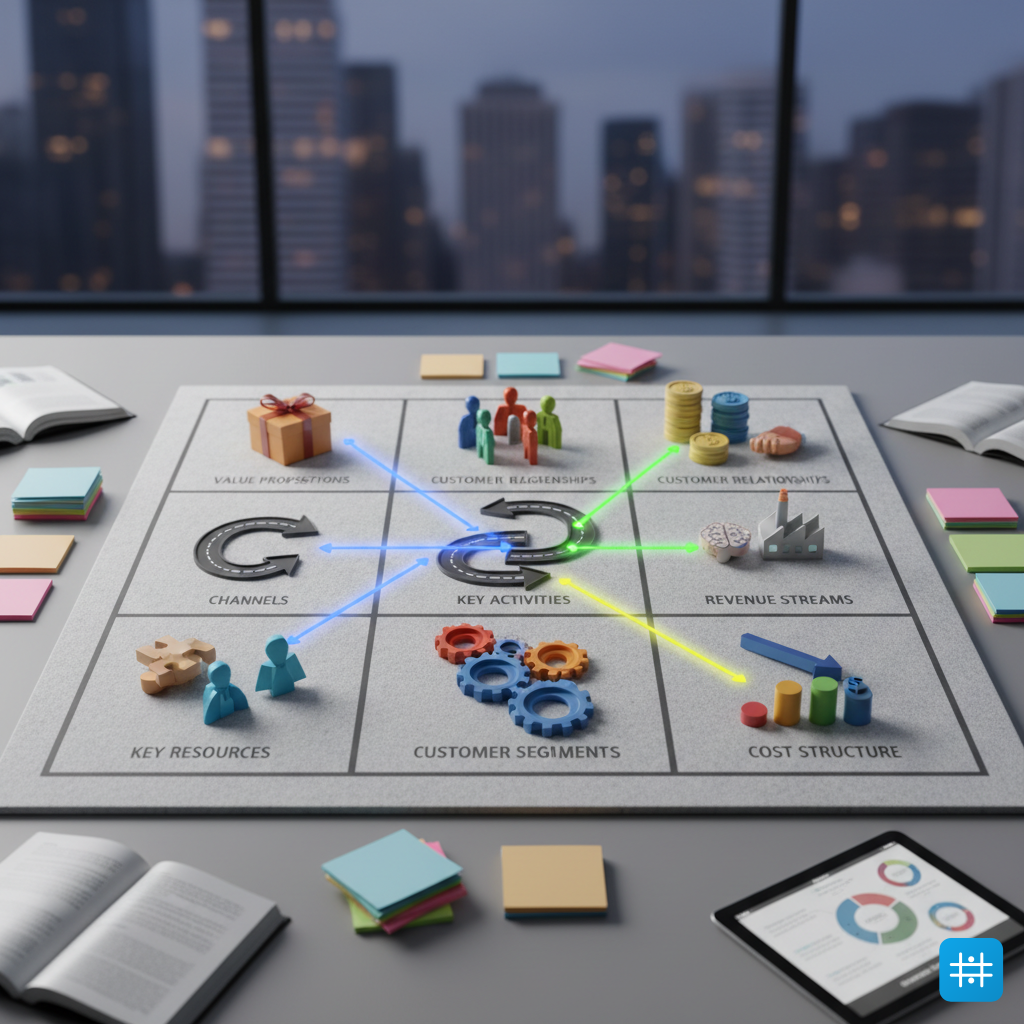
Gone are the days when a 50-page business plan was the first step to starting a company. In today's fast-paced market, agility is key. Enter the Business Model Canvas (BMC). Created by Alexander Osterwalder and Yves Pigneur, this single-page visual framework allows you to describe, design, challenge, and invent your business model systematically.
The BMC forces teams to take a holistic view, visualizing how every part of the business—from customers to costs—interconnects. It is broken down into nine fundamental building blocks.
The 9 Interconnected Building Blocks
The canvas is best understood by reading it from right (Value and Customers) to left (Infrastructure and Costs).
1. Value Propositions (The Offering)
This is the core of your business. Your Value Proposition (VP) is the specific bundle of products and services that creates value for a specific segment. It explains why customers choose you over a competitor.
- Focus Areas: Novelty, performance, customization, design, price, or convenience.
- Example: Tesla’s VP isn't just "a car"—it’s high performance combined with sustainable energy and software updates.
2. Customer Segments (The Who)
No business exists without customers. You must define exactly who you are serving.
- Mass Market: Targeting a broad audience (e.g., Consumer electronics).
- Niche Market: Specialized requirements (e.g., Auto parts for vintage cars).
- Multi-Sided Platform: Serving two interdependent groups, like Uber connecting riders and drivers.
3. Channels (The Delivery)
Channels are how you communicate with and deliver value to your customers. This includes five phases: Awareness, Evaluation, Purchase, Delivery, and After-Sales Support.
- Strategy: A SaaS company might use social media for Awareness, a free trial for Evaluation, and their website for Delivery.
4. Customer Relationships (The Interaction)
This defines the nature of your relationship with the customer, ranging from high-touch to low-touch.
- Personal Assistance: Human interaction (e.g., dedicated financial advisors).
- Automated Services: Personalized recommendations via AI.
- Communities: Users helping users (e.g., Wikipedia or Forums).
5. Revenue Streams (The Financial Engine)
This block asks: What value are customers truly willing to pay for?
- Transaction Revenue: One-time payments.
- Recurring Revenue: Ongoing payments like subscriptions or licensing.
- Pricing: Can be fixed (predetermined) or dynamic (negotiation/yield management).
6. Key Resources (The Assets)
These are the assets required to make the business model work.
- Physical: Factories, warehouses (e.g., Amazon).
- Intellectual: Patents, software, brand (e.g., Google's algorithms).
- Human: Essential talent (e.g., specialized scientists).
- Financial: Cash reserves or lines of credit.
7. Key Activities (The Doing)
The most important actions your company must perform to operate successfully.
- Production: Manufacturing and delivery.
- Problem Solving: Consultancies and service firms generating solutions.
- Platform Management: Companies like Visa or LinkedIn maintaining their infrastructure.
8. Key Partnerships (The Network)
Who helps you operate? Partnerships reduce risk and optimize operations.
- Optimization: Outsourcing to reduce costs.
- Risk Reduction: Alliances in competitive markets.
- Resource Acquisition: Licensing technology or accessing new channels.
9. Cost Structure (The Expenses)
What does it cost to operate the model? This stems directly from your Resources, Activities, and Partnerships.
- Cost-Driven: Minimizing costs through automation (e.g., low-cost airlines).
- Value-Driven: Focusing on premium value regardless of cost (e.g., luxury brands).
Leveraging the Canvas for Innovation
The BMC is a dynamic tool, not a static document.
- Map Your Competitors: Create a BMC for your closest competitor. It will reveal their strategic choices and highlight where you can differentiate.
- "What If" Scenarios: Use the canvas to prototype. What if you changed your Revenue Stream from "Asset Sale" to "Subscription"? How does that change your Relationship and Channels?.
- Validate Assumptions: Identify the riskiest connections (usually between Value Proposition and Customer Segment) and use Lean Startup methods to test them.
FAQ: Business Model Canvas
Q: How often should I update my BMC? A: Continuously. As you learn from the market (using Lean Startup methods), your canvas should evolve to reflect new facts.
Q: Can I use the BMC for a non-profit? A: Yes. While the "Revenue" block might change to "Funding Sources" and "Profit" to "Social Impact," the logic of value creation and delivery remains the same.
Q: Where do I start filling it out? A: Most experts recommend starting with Customer Segments and Value Propositions because if you don't have product-market fit there, the rest of the canvas doesn't matter.
Recommended Reading
Lean Startup in Practice
Master Lean Startup methodology with our complete guide. Learn Build-Measure-Learn loops, MVP development, validated learning, innovation accounting, and pivot strategies. Reduce startup risk with proven scientific approaches.
Customer Validation Playbook
Stop building products nobody wants. Discover 10 proven customer validation techniques including Problem Interviews, Concierge MVP, Wizard of Oz testing, and Landing Page experiments. Learn how to test your ideas before investing.
Revenue Model Decisions
Compare 10+ revenue models for startups including subscriptions, freemium, marketplace, and advertising. Learn which monetization strategy fits your business with real examples from Netflix, Spotify, Airbnb, and Salesforce.